
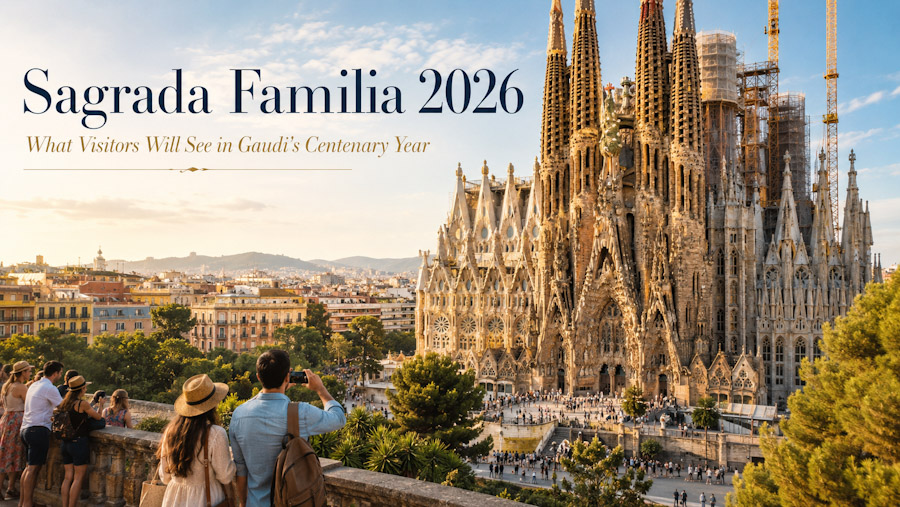
On the evening of 10 June 2026, exactly one hundred years after Antoni Gaudi died, drones drew the architect's face in the sky over Barcelona while fireworks burst beside a tower that did not exist a decade ago. Pope Leo XIV had just blessed the Tower of Jesus Christ, the central spire of the Sagrada Familia, before some 8,000 people: 4,000 inside the basilica and another 4,000 following the mass on screens outside, facing the Nativity facade. With that ceremony, the building Gaudi barely saw begin reached its full height of 172.5 meters and became the tallest church in the world, surpassing Ulm Minster in Germany.
For travelers, 2026 is therefore a once-in-a-generation moment to visit. The skyline Gaudi imagined in the 1880s is finally visible: all six central towers, dedicated to Jesus Christ, the Virgin Mary and the four Evangelists, now stand complete against the Barcelona sky. But the centenary year also comes with practical changes, record demand for tickets and one persistent misunderstanding worth clearing up before you go.
First, the Myth: The Sagrada Familia Is Not Finished
Many headlines this year have declared the basilica "completed." That is not accurate. What was completed is the architectural structure of the central towers, crowned by the Tower of Jesus Christ. The Glory facade, which will one day be the main entrance on Carrer de Mallorca, is still under construction, along with its four remaining apostle towers and a controversial monumental stairway. The building authority itself speaks of roughly another decade of work, with sculptural details and the Glory facade expected to occupy crews well into the 2030s. Inside the central tower, finishing work on cladding and a lift is planned to continue for a couple more years.
In other words, the visitor of 2026 sees a basilica that is substantially, but not entirely, complete. The silhouette is done; the front door is not. Gaudi, who famously answered questions about the timeline with "My client is not in a hurry," would probably not be surprised.
The Tower of Jesus Christ: The New Summit of Barcelona
Construction of the central tower began on 16 October 2018, when the first stone panels were placed 85 meters above the ground. The final piece of its crowning cross was installed on 20 February 2026. The four-armed cross, about 17 meters tall, is made of glass and white glazed ceramic, designed to catch sunlight by day and glow at night. The terminal section beneath it carries an inscription from the Gloria of the mass: "Tu solus Sanctus, Tu solus Dominus, Tu solus Altissimus." Inside the upper arm sits a sculpture of the Lamb of God by Italian artist Andrea Mastrovito.
A detail visitors love: according to the tradition maintained by the basilica, Gaudi deliberately kept his tower just below the height of Montjuic hill, because the work of man should not surpass the work of God.
Can you go up the new tower? Not yet. A viewing point inside the cross itself, at around 164 meters and with room for only a handful of people at a time, is planned and will be the highest accessible spot in Barcelona, but as of mid-2026 tickets are not on sale and no opening date has been confirmed. Do not book anything that promises access to the Tower of Jesus Christ.
What You Can Actually Visit in 2026
The interior of the basilica is fully complete and remains the emotional heart of any visit: the forest of branching stone columns, the east and west stained glass that floods the nave with cool blues in the morning and burning oranges toward sunset, the apse and the altar beneath its canopy. Every ticket also includes the museum, with Gaudi's models, drawings and period photographs, and the crypt, where the architect is buried in the chapel of Our Lady of El Carme. Gaudi was struck by a tram on 7 June 1926 on his way to the construction site and died three days later; standing at his plain stone tomb, beneath the church he never saw finished, is for many visitors the most moving moment of all.
Two towers are open to the public, each with a separate timed ticket. The Nativity Tower, on the east side, rises through the facade Gaudi built in his lifetime and is the choice for anyone who wants to see his original sculpture up close, with morning light and views toward the sea. The Passion Tower, on the west side, overlooks the Eixample grid, Montjuic and Tibidabo, framed by Josep Maria Subirachs's angular 20th-century sculpture, and is the better panorama in the afternoon. In both cases a lift takes you up and you walk down a narrow spiral staircase of roughly 300 steps; bags go into lockers first, and the towers are not accessible to visitors with reduced mobility.
Tickets and Practical Information
All tickets are timed, nominative and checked against photo ID, and they should be bought only on the official website, sagradafamilia.org. At the time of writing, basic self-guided entry costs 26 euros, entry with the official audioguide app 30 euros, and entry with audioguide plus one tower 40 euros; guided tours in several languages are also available. Children under 3 enter free, visitors under 16 must be accompanied by an adult, and discounts exist for students, under-30s and Barcelona residents. In this centenary year demand is exceptional: tower slots routinely sell out weeks in advance in high season, so book as soon as your dates are fixed.
A few useful rules and tips. The first hour of the day, from 9:00 to 10:00, is a designated quiet hour with earphones required, and it is also the calmest time to visit. Around midday and before sunset the stained glass is at its most spectacular. Dress as you would for a church, expect airport-style security, and allow at least two hours, or closer to three with a tower.
Getting There and the Best Views
The basilica occupies a full block of the Eixample at Carrer de Mallorca 401. The Sagrada Familia metro station (lines L2 and L5) exits directly onto the square facing the Nativity facade, and buses 19, 33, 34, 50 and 51 stop within a block. There is no visitor parking, so do not drive.
For photographs of the completed tower ensemble, the classic spot is the reflecting pool in Placa de Gaudi on the Nativity side, best in early morning light. Avinguda de Gaudi, the diagonal avenue linking the basilica with the Hospital de Sant Pau, offers a dramatic compressed perspective, and the Passion side glows in the late afternoon.
The Centenary Continues
The inauguration was the high point, but the Gaudi centenary is far from over. The basilica's own commemorative program includes 31 events running from autumn 2025 until Christmas 2026, from concerts and exhibitions to academic lectures, within a wider "Gaudi Year" declared an event of exceptional public interest by the Spanish government. One date stands out: on 30 November 2026 the Tower of Barnabas will be specially illuminated to mark one hundred years since its completion in 1926, the only tower Antoni Gaudi ever saw finished. Visiting in 2026 means standing inside a promise that took 144 years, thousands of anonymous craftsmen and no public money at all, financed entirely by donations and the tickets of visitors like you, to come this close to fulfillment.