
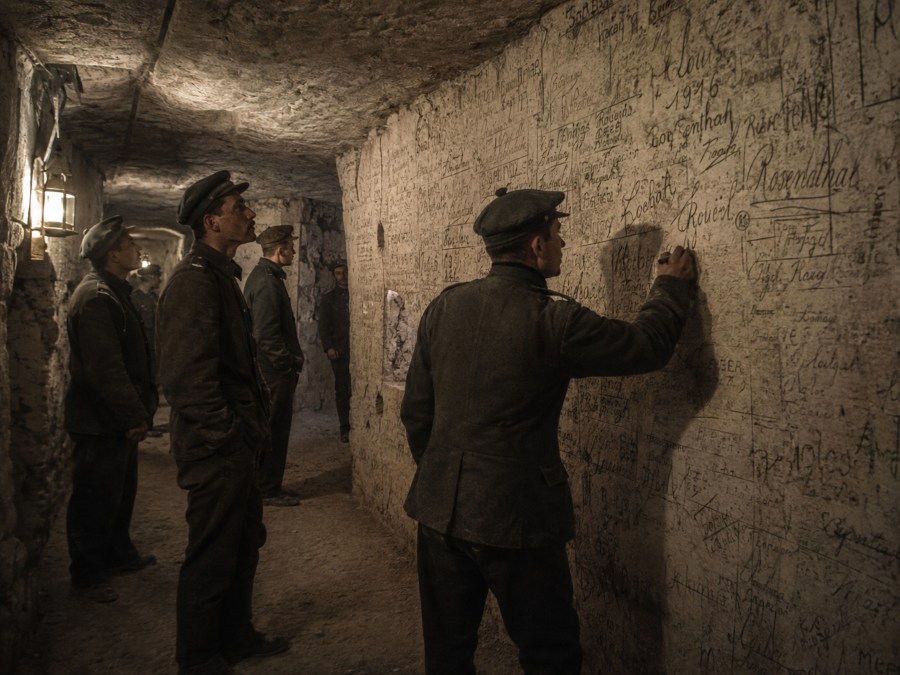
You need a torch. That is the first thing you learn about the underground city of Naours, and the reason its greatest treasure went unnoticed for more than a century. Thirty-three metres below a low green hill in Picardy, in a chalk corridor where the temperature never moves from about ten degrees, the beam catches something on the wall that stops you: a name, written in ordinary pencil, in a firm hand, followed by a place and a date. Wilfred. New South Wales. July 1916.
He wrote it a few kilometres and a few weeks from the worst day in his country's military history. The Somme offensive was grinding through the fields above his head. And he had come down here, on his day off, to look around.
The underground city of Naours, fourteen kilometres north of Amiens, is one of the strangest heritage sites in France, and one of the most misunderstood. It is routinely described as a wartime bunker, dug to shelter soldiers from artillery. It is nothing of the kind. It is a village that learned, over centuries, to disappear into the ground, and the soldiers who left their names on its walls were not hiding at all. They were sightseeing.
A City Carved Out of Fear
The chalk plateau of northern France is soft, dry and easy to cut, and people have been quarrying it since the Middle Ages, for building stone and for marl to spread on the fields. What makes Picardy different is what happened next. This was one of the most frequently invaded stretches of Europe, a corridor for armies moving between the Low Countries and Paris, and from roughly the fifteenth century onward the villagers began converting old quarries into hiding places. In the Picard dialect, to hide is to mucher, and these refuges are called muches. Dozens of them survive across the Somme, the Nord and the Pas-de-Calais.
Naours is the largest and most elaborate of them all. At its height the network ran to some two kilometres of galleries, twenty-eight of them, organised like streets and lined with rooms grouped into islands, with common halls and a chapel. Counts of the rooms vary between roughly a hundred and thirty and three hundred depending on what is included, but the scale is not in dispute: this was a settlement capable of absorbing an entire village, perhaps two thousand people, along with their livestock and their food stores.
The detail that best captures the ingenuity of the place is the chimneys. A hidden city needs fire, and fire makes smoke, and smoke betrays. So the builders drove their flues horizontally through the chalk until they connected with the chimney of an ordinary house on the surface. The smoke of two thousand hidden people rose from a farmhouse hearth, and an army marching past saw nothing worth stopping for.
When the Digging Peaked
Popular accounts tend to push the refuge deep into the Middle Ages, and there is a romantic version in which frightened peasants fled underground from Viking raiders. The quarrying may indeed be old, but archaeology tells a more specific story about when Naours was actually lived in. Excavations coordinated by the French national archaeology institute, Inrap, recovered inscriptions, coins, pottery and musket balls that point to intense occupation in the early seventeenth century, during the Thirty Years War, when armies crossed and recrossed northern Europe burning and looting as they went. The sixteenth and seventeenth centuries, not the ninth, were the great age of the muches.
A note of caution for anyone reading around the subject: several otherwise reliable French sources place this peak in the early eighteenth century while still naming the Thirty Years War, which ran from 1618 to 1648. The war is right; the century is a slip that has been copied from one page to another.
Peace, when it came, changed the tenants rather than emptying the tunnels. Under Louis XVI the galleries were taken over by the faux-sauniers, the salt smugglers who ran contraband past the hated gabelle, the salt tax, and who established a depot down here. A refuge for survival became a warehouse for crime, on the same logic of concealment. After the Revolution the visits dwindled, the entrances closed over, and the city under the hill was forgotten.
The Priest With a Lantern
It came back in December 1887, when the village priest, Abbe Ernest Danicourt, an enthusiastic amateur archaeologist, went looking for it and found it. He was a good enough showman to publish a visitor guide the following year, recommending routes through the galleries, and by 1906 the site was formally open to the public. This matters, because it explains everything that happened next. By the time the Great War arrived, Naours was already a local attraction, the sort of curiosity that appears in guidebooks and gets recommended to visitors with an afternoon to fill.
The Tourists of the Somme
In late 2013 the local authority took over management of the site and asked a resident archaeologist, Gilles Prilaux of Inrap, to do something narrow and technical: pin down the dates of the network. He did that. Then he walked the galleries with a torch, looked properly at the walls, and found something nobody had catalogued.
Names. Thousands of them. The survey carried out between 2013 and 2018 recorded more than three thousand inscriptions, most in pencil, many with a nationality, a unit, a date, sometimes a home address. Early estimates put the figure closer to two thousand and it climbed as the work went on, which is worth remembering when you see different totals quoted. French soldiers appear from 1915. From 1916 the Australians arrive in force, and they dominate the corpus; published estimates of their share range from about half to as much as four fifths, depending on how the count is done. There are British, Canadian, American and Indian names too.
Why Australians? Because they were billeted nearby, at Vignacourt, behind the Somme front, and because word got round. The soldiers' own letters make the purpose unmistakable. In July 1916 a young Australian, Alexander Patterson, wrote home to his mother describing an underground town dug beneath a great hill, made hundreds of years ago, where the people used to hide whenever France was invaded. A diary from the turn of 1916 into 1917 records a party of ten men setting off for the famous caves near Naours, and marvels that the place holds about three hundred rooms, one of them a thousand metres long, and that an entire division with men, horses, guns and transport could fit inside.
These are the words of men on an excursion. That is the discovery that reoriented the research at Naours: not shelter, but leisure. Behind the lines of the deadliest battle of the war, soldiers with a free afternoon went to see the tourist attraction, and signed the wall like visitors have always signed walls. Alexander Patterson's brother James was wounded at Pozieres on 9 August 1916. The contrast between the two facts, the day out and the casualty list, is the whole strangeness of the site.
Why the Names Are Still There
Pencil on chalk should not survive a century. These did, thanks to the same conditions that made the muches habitable: total darkness, and a temperature that holds steady near ten degrees, which keeps the mould at bay. There is a second reason, and it is unexpected. German forces occupied the galleries during the Second World War and used them for passive defence, and they left the writing alone. Better than that, a handful of German graffiti were added, so the walls now carry two wars in the same hand-height band of chalk.
Since then the archaeology has turned into genealogy. Prilaux began cross-referencing the names against Australian, British and French military archives, which for the Australians are unusually rich, and the identifications began to produce reunions. In 2019 an Australian visitor, Janet Pietsch, stood in a gallery and read the inscription left by her great-uncle a century earlier. Fred Jenkins of Bendigo came home from the Somme and died at the age of ninety-one.
Going There
Naours sits in the Somme, in the Hauts-de-France region, an easy detour from Amiens and from the Somme battlefield memorials. Visits are guided, the galleries are level and walkable, and the ceilings run between roughly 1.6 and 2 metres, so tall visitors should watch their heads. Bring a jacket whatever the season: the ten degrees underground is not a metaphor. Above ground there is a museum of old trades and an interpretation centre devoted to the graffiti survey, which is where the Great War material is explained in detail. Check opening times before travelling, since they vary by season.
What stays with you is not the engineering, impressive as it is. It is the handwriting. A city built by people who wanted to leave no trace at all, its walls covered in the names of men who wanted to leave one, written a few weeks before many of them lost the chance.