
A Renaissance landscape of power and water
North of central Florence, in the low hills of Castello, a long tree lined avenue leads to a pale villa that once helped define the image of Tuscany. Today Villa di Castello feels calm and almost private. Yet for centuries this residence of the Medici family was a visible statement of power, culture and hydraulic ingenuity, built to impress visitors and to celebrate rule over Florence and its territory.
The villa stands close to other Medici estates such as La Petraia and La Topaia. Together these houses formed a constellation of country residences around the city. Castello later became part of the group of Medici villas and gardens in Tuscany that are recognised as a World Heritage site. The story of the building and its gardens, however, begins much earlier than the Renaissance.
The name Castello comes from the Latin word castellum, a term used for the cisterns that once punctuated a Roman aqueduct in this area. In the second century the senator Marco Opellio Macrino ordered the construction of an aqueduct with reservoirs that were known locally as castelli. Over time the small settlement that grew near one of these structures became Castello dell Olmo, in memory of an elm that stood nearby.
A villa already stood here in the fourteenth century. Around 1477 Lorenzo and Giovanni di Pierfrancesco de Medici, members of a more popular branch of the family, bought the property and enlarged it. Lorenzo became one of the main patrons of Sandro Botticelli and commissioned The Birth of Venus and Primavera for Castello. The paintings later moved to the Uffizi, but their original home underlines the cultural ambitions that were linked to this rural building.
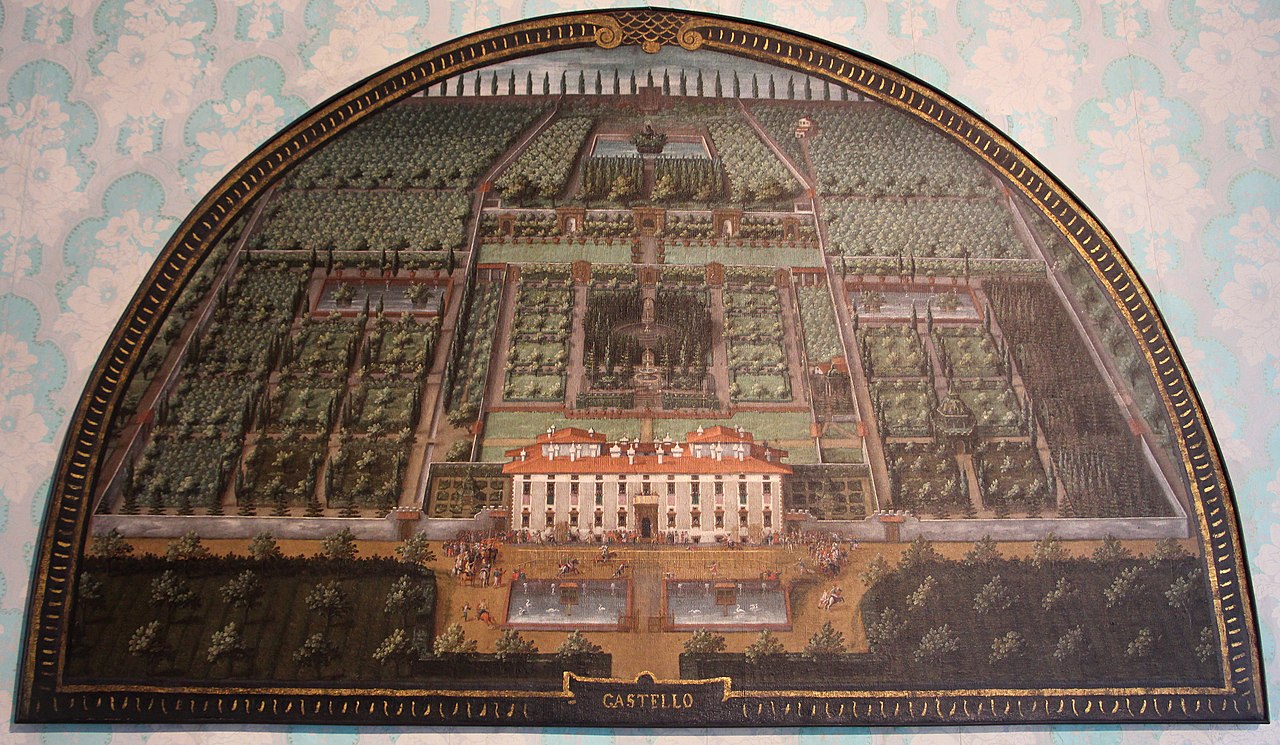
When Cosimo became duke of Florence in 1538, he asked the architect Giorgio Vasari to remodel the house and commissioned Niccolo Tribolo to design a new garden that would function as a place of representation and as a symbolic map of Tuscany. The garden developed into one of the earliest and most influential examples of the formal Italian style and later inspired the Boboli Gardens.
Today visitors move through three terraces with flower beds, fountains, citrus trees and the famous Grotta degli Animali, an artificial cave covered with mosaics and animal groups in coloured stone. Hidden pipes once sent water from the floor, the ceiling and even from the mouths of marble beasts, creating a cool mist and playful surprises for guests.
Beyond the terraces lie small secret gardens, a wooded slope with the bronze figure of January or the Apennine by Bartolomeo Ammannati and a nineteenth century park in the English style. Inside the villa, which now houses the Accademia della Crusca, the Sala delle Pale displays more than one hundred and fifty painted wooden paddles that honour members of the language academy.
Since 1984 the gardens of Castello have formed a state museum. Work on trees, lawns, fountains, citrus houses and waterworks has revived much of the original design. In 2013 the estate received the national prize for the most beautiful public park in Italy, confirming that this quiet place in the hills still speaks with a strong historical voice.